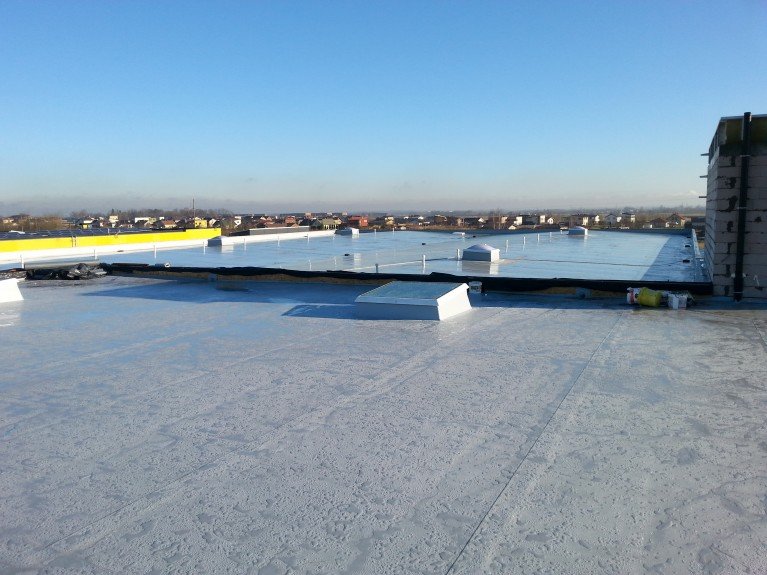
What a PVC roofing system is
A PVC membrane is plasticised PVC with a reinforcing scrim. Rolls are laid with overlaps, seams are hot-air welded, and the membrane is either mechanically fastened or held down by ballast. The weld becomes homogeneous with the sheet — watertightness depends on weld quality and on checking it.
Stogrenta installs membranes by the Norwegian manufacturer Protan. Mechanically fastened systems use Protan SE (polyester reinforced); overlays on old bitumen use Protan EX with 180 g/m² felt backing; terraces use Protan T; ballasted and inverted roofs use Protan G / G-FR; water-pressure and parking applications use Protan GG (SINTEF TG 2010 and TG 2008).
Fixing
Wind tries to lift the membrane off the roof. Suction is highest at corners and edges, so more fasteners go there. The number is calculated for each roof.
Mechanical fixing in the laps: number and spacing of fasteners follow the wind uplift calculation for each roof zone. SINTEF TG 2010 gives a design capacity of 627–912 N per fastener for Protan SE 1.2, depending on the fastening system and substrate. On weak substrates the fastener-to-deck connection may govern, which is why pull-out tests are carried out on refurbishment.
On polystyrene and in re-roofing Protan SE needs a separate migration barrier. Ballasted membranes (Protan G) are not mechanically fastened except for linear fixing at upstands; ballast goes down immediately after welding.
Seams and seam checks
Laps are at least 120 mm at the side and 80 mm at the ends; hand-welded seams finish 20–40 mm wide. Every seam is checked with a metal probe, and machine welding includes trial welds and peel tests (NSAI 06/0262 — every 200 m).
Advantages and limitations
Advantages
- no open flame on the roof;
- welded, not glued, seams;
- light system — useful on long-span decks;
- repairable by welding patches;
- white membrane for roofs with solar panels (Protan Cool Roof).
Limitations
- not directly compatible with polystyrene or bitumen — separation layer needed;
- needs protection from mechanical damage — walkways to plant;
- fire classification depends on the substrate — checked in design.
Terraces and green roofs
Terraces use Protan T (exposed, mechanically fastened) or G/GG under a protective layer. For extensive green roofs SINTEF lists Protan SE 1.8 mm; for intensive green roofs Protan G or GG.